
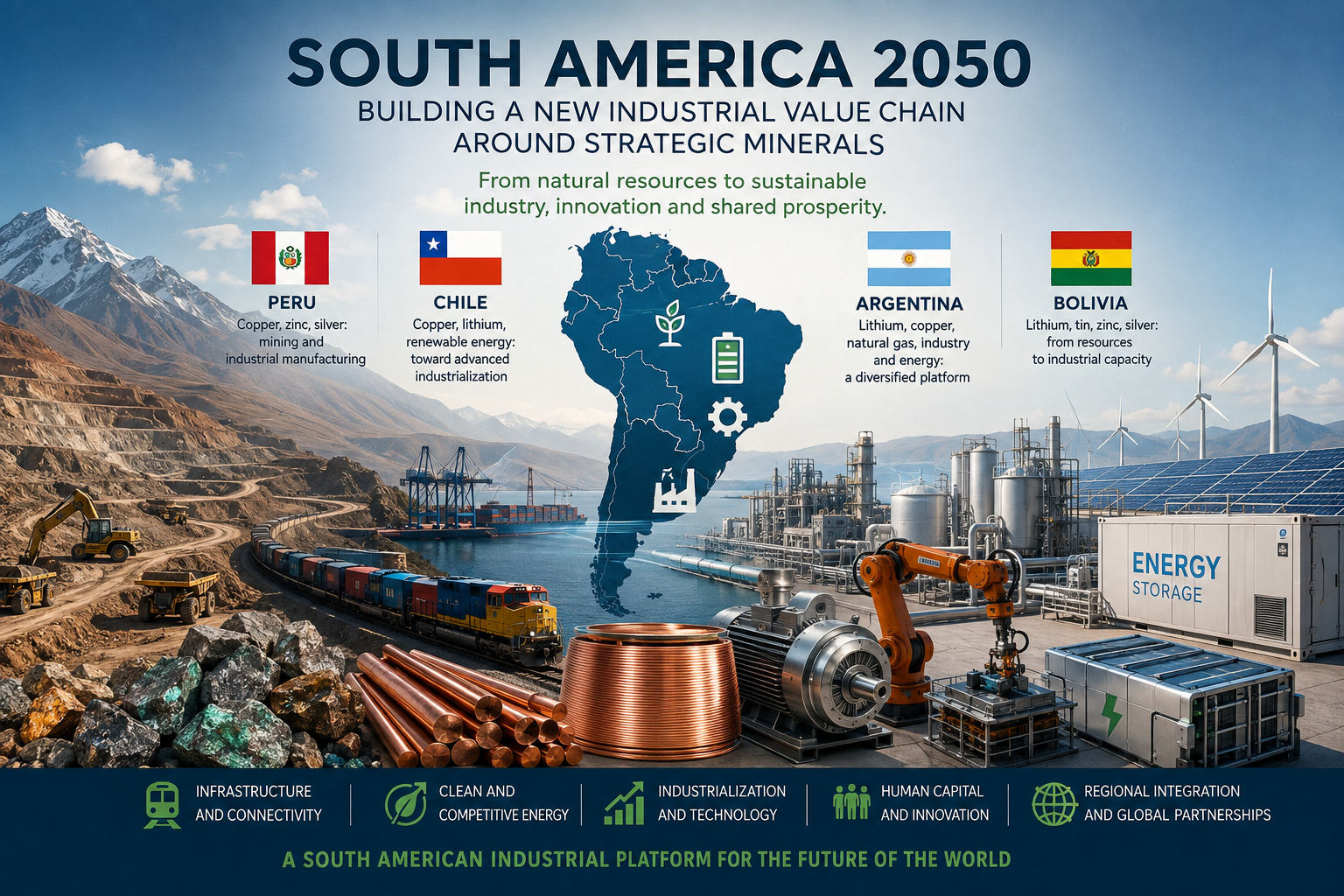
Peru, Chile, Argentina and Bolivia and the opportunity to transform natural resources into a regional industrial platform
South America could play a decisive role in the global economy of the coming decades.
Peru, Chile, Argentina and Bolivia possess some of the world’s most important reserves and production potential in copper, lithium, iron, zinc, silver, tin and other strategic minerals. These resources will become increasingly important as the global economy moves toward electrification, renewable energy, energy storage, advanced manufacturing and new technologies.
The major opportunity, however, is not simply to extract more minerals.
It is to transform them within the region and build industrial value chains around them.
If Peru, Chile, Argentina and Bolivia were able to coordinate investments in infrastructure, energy, logistics, technology and industrial processing, they could potentially develop one of the world’s most important regional platforms for strategic minerals and related manufacturing by 2050.
Important note: The figures and scenarios presented in this article are hypothetical and illustrative. They do not constitute official economic forecasts or institutional projections.
From Mining to Industrial Value Creation
For decades, a significant part of South America’s economic model has relied on the export of commodities.
Mining has generated foreign currency, employment, tax revenues and international investment. However, exporting raw or minimally processed materials also means that a significant portion of the potential value created further along the supply chain is captured elsewhere.
The strategic opportunity for the coming decades is therefore to progressively move from:
Extraction → Concentration → Refining → Processing → Manufacturing → Technology
The objective would not simply be to produce more minerals, but to create an industrial ecosystem around those minerals.
Consider copper as an example:
Copper → Refining → Rod → Cables → Motors → Transformers → Electrical Equipment → Industrial Machinery
Every additional stage can generate investment, skilled employment, technological capabilities, industrial know-how and higher economic value.
⸻
A Potential Economic Scenario for 2050
Starting from a combined current GDP of approximately US$1.4 trillion, a hypothetical long-term scenario can be developed for Peru, Chile, Argentina and Bolivia.
Combined potential
Under a scenario of strong industrialization, regional integration and sustained investment, the four economies could potentially reach a combined GDP of approximately US$3–4 trillion by 2050.
The key difference between the two scenarios would not simply be the volume of minerals extracted.
The fundamental question would be:
How much of the value generated by those resources remains within the region?
⸻
🇵🇪 Peru: From Copper and Zinc to Industrial Manufacturing
Peru has a particularly strong position in copper, zinc, silver and other strategic minerals.
The opportunity is to use this mineral base as the foundation for increasingly sophisticated industrial activities.
A potential copper value chain could develop as follows:
Copper → Refining → Rod → Cables → Motors → Transformers → Electrical Machinery
Zinc and other metals could support industries focused on:
• refining;
• alloys;
• industrial components;
• construction materials;
• machinery;
• specialized metal products.
A Peru that combines mining with energy, infrastructure, manufacturing, technology and human capital could substantially increase the economic value generated by each tonne of mineral produced.
Under an ambitious industrialization scenario, Peru could potentially move toward a GDP in the range of US$800 billion–1 trillion by 2050, subject to major improvements in productivity, infrastructure, investment, institutional stability and human capital.
⸻
🇨🇱 Chile: Copper, Lithium and Renewable Energy
Chile has an exceptionally strategic combination of resources and energy potential:
Copper + Lithium + Renewable Energy
The country could use these advantages to develop industries associated with:
• refined copper;
• copper products and electrical cables;
• lithium chemicals;
• battery materials;
• electrical components;
• energy storage;
• green hydrogen and derivatives.
The combination of mining and competitive renewable energy could become one of Chile’s strongest strategic advantages.
The objective would not simply be to export copper and lithium, but to use these resources as a platform for attracting industrial investment and developing higher-value manufacturing capabilities.
⸻
🇦🇷 Argentina: A Diversified Industrial and Energy Platform
Argentina offers a particularly powerful combination:
Lithium + Copper + Natural Gas + Agriculture + Industry + Energy
The development of lithium and copper resources could be integrated with the country’s existing industrial and energy base.
Potential areas of development include:
• lithium chemicals;
• battery materials;
• battery manufacturing;
• energy-storage systems;
• industrial machinery;
• electrical components;
• energy infrastructure;
• technologies related to the energy transition.
Argentina could therefore become one of South America’s major industrial and energy hubs.
⸻
🇧🇴 Bolivia: Turning Strategic Resources into Industrial Capacity
Bolivia possesses significant resources of lithium, tin, zinc, silver and other minerals.
Its major challenge will be to transform these resources into an industrial platform capable of capturing a larger share of the value generated within the country.
This will require substantial investment in:
• transport infrastructure;
• railways and logistics;
• competitive energy;
• processing technology;
• foreign investment;
• skilled human capital;
• refining and processing capacity;
• access to international markets.
Lithium represents a particularly important opportunity, but Bolivia’s long-term strategy should not depend on a single mineral.
Diversification into zinc, tin, silver and other resources could provide the foundation for a broader industrial ecosystem.
⸻
🌎 Regional Integration: Building Cross-Border Value Chains
The greatest opportunity may emerge if these four countries stop viewing their mineral resources exclusively from a national perspective and begin developing complementary regional value chains.
The model could function as an integrated industrial platform.
Lithium
🇧🇴 Bolivia + 🇦🇷 Argentina + 🇨🇱 Chile
Lithium → Chemicals → Battery Materials → Cells → Batteries → Energy Storage
Copper
🇨🇱 Chile + 🇵🇪 Peru
Copper → Refining → Rod → Cables → Motors → Transformers → Electrical Components
Iron and Other Strategic Metals
🇵🇪 Peru + 🇨🇱 Chile + 🇦🇷 Argentina + 🇧🇴 Bolivia
Minerals → Refining → Steel & Alloys → Machinery → Vehicles → Infrastructure
Such an approach could allow different stages of production to be located according to each country’s competitive advantages.
⸻
Infrastructure: The Essential Foundation
No regional industrial strategy can succeed without modern infrastructure.
Railways, highways, ports, bioceanic corridors, electricity networks, transmission infrastructure and efficient logistics systems will be essential to connect mining regions with industrial centers and international markets.
A more integrated network linking mineral-producing regions with ports on both the Pacific and Atlantic could reduce logistics costs and facilitate regional trade.
It could also allow a mineral extracted in one country to be processed in another and transformed into an industrial product in a third country before reaching the international market.
This is where regional cooperation could create a significant competitive advantage.
⸻
Beyond a Mining Alliance: A South American Industrial Platform
The most ambitious objective would not simply be to create an organization of mineral-exporting countries.
It would be to establish a regional platform for strategic minerals, industrial development and technological cooperation.
Such cooperation could focus on:
1. Regional infrastructure
Railways, roads, ports, logistics corridors and integrated transportation networks.
2. Energy
Cross-border electricity interconnections and large-scale development of competitive renewable energy.
3. Mining
Cooperation in attracting investment, developing new projects and improving mining standards.
4. Refining and processing
Building regional capacity to refine and transform strategic minerals.
5. Technology
Research and development in batteries, advanced materials, machinery, energy systems and industrial automation.
6. International capital
Creating investment structures capable of attracting institutional and international capital.
7. Human capital
Developing universities, technical institutes, research centers and specialized professional training.
⸻
Could South America Create a “Strategic Minerals Alliance”?
A deeper level of cooperation between Peru, Chile, Argentina and Bolivia could raise an even more ambitious question:
Could these countries coordinate part of their strategic-mineral policies and international market positioning?
This would not necessarily mean replicating the OPEC model.
A different approach could focus on:
• market intelligence;
• common standards;
• infrastructure;
• investment;
• technology;
• responsible production;
• international marketing;
• industrial processing;
• supply-chain development.
Instead of competing primarily to export raw materials, the four countries could cooperate to increase the strategic and economic value of their resources.
⸻
An Opportunity for Europe and International Investors
Such a transformation would also create significant opportunities for European and international companies operating in:
• engineering;
• industrial machinery;
• mining technology;
• renewable energy;
• infrastructure;
• logistics;
• automation;
• refining;
• advanced materials;
• financial services;
• certification and traceability;
• environmental technologies.
Europe is seeking to diversify and strengthen its supply chains for critical and strategic minerals.
South America, meanwhile, needs capital, technology, infrastructure and access to international markets in order to transform its mineral resources into higher-value industrial production.
This creates a powerful strategic complementarity.
Europe has technology, industrial capabilities and capital.
South America has resources, energy potential, land, industrial opportunities and access to strategic minerals.
The development of long-term partnerships between the two regions could therefore become increasingly important.
⸻
A Vision for 2050
The most significant opportunity for South America would not simply be to become one of the world’s largest exporters of minerals.
It would be to become one of the world’s leading industrial and technological hubs built around strategic minerals.
The distinction is fundamental.
Exporting one tonne of raw mineral generates a certain level of economic value.
Refining it generates more.
Transforming it into an industrial component generates significantly more.
Using that component to manufacture machinery, vehicles, electrical systems, batteries or advanced technologies allows the region to capture a much larger share of the global value chain.
The strategic challenge for Peru, Chile, Argentina and Bolivia is therefore to move from:
“We have the resources.”
to:
“We have the resources, and we have the capacity to transform them.”
If this transition is supported by modern infrastructure, competitive energy, legal certainty, investment, technology, education and regional cooperation, South America could enter 2050 with a substantially stronger position in the global economy.
The region’s greatest strategic asset would not simply be the amount of minerals beneath its soil.
It would be its ability to transform those minerals into industry, technology, skilled employment, knowledge and sustainable economic development.
A strategic opportunity for the next generation
For chambers of commerce, investors, financial institutions, technology companies and industrial groups, this potential transformation represents more than a mining opportunity.
It represents the possibility of participating in the construction of a new South American industrial ecosystem.
The next decades could determine whether the region remains primarily a supplier of raw materials—or becomes a global partner in the production of the technologies, infrastructure and industrial goods required by the 21st-century economy.
The figures and scenarios presented in this article are hypothetical and illustrative. They are not official forecasts. Their realization would depend on a wide range of economic, political, technological, environmental, institutional and geopolcal factors.